New Pictures!!
These are from pretty much the whole semester so far: Manu, Monteverde, Poas Volcano, Carara, Atenas, community outreaches, etc.
Some highlights:
-Monteverde. In total. It's a small (but growing) town in the mountains. The ecosystem up there is called "cloud forest" because it's so high up it gets a lot of precipitation from being IN the clouds. It's very surreal looking, all of the trees have tons of epiphytes (bromeliads, orchids) growing on every surface and it's almost dripping wet at all times. There's also swampy areas, and once you get up high enough you reach elfin forest, where all the trees are short from the wind exposure. Over the course of our stay we hiked the trails in Monteverde park twice, and one of the interns and I stayed an extra night with a professor and his family. We got to wander around the town of Monteverde and see a band of local scientists play in a bar. I get the sense that there's a really big scientific community in the town, I visited or heard of at least 4 research stations there.
Independence Day (Sept 15) in town. The parade was very similar, and yet very dissimilar to parades at home. You do have the marching bands, the baton twirlers, the floats, etc. But you also have girls with big skirts and guys doing rope tricks, and women in THREE INCH HEELS in a PARADE. The food was very similar. No hot dogs or burgers, but meat cooked over a grill, served on a skewer with a tortilla. Close enough (and delicious).
We've had a couple of outreaches with a local old folks group, called the Tercera Edad (Third Age). It's a bunch of active little old ladies and men who get together, usually at the church. Twice now we've done arts and crafts with them, and it's pretty fun. The little old ladies get pretty creative, and they're really happy to just talk to young people, even if we don't always understand them.
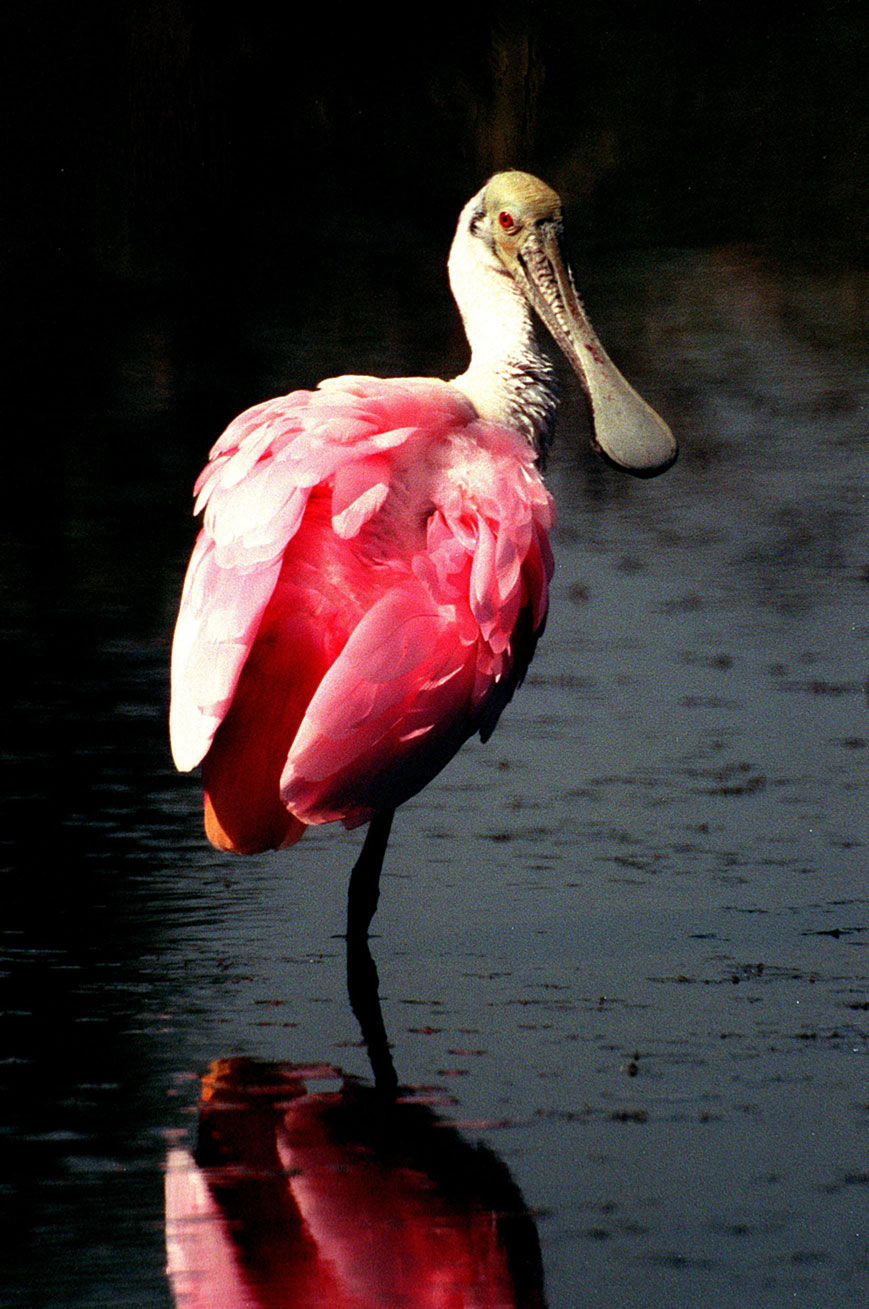
On our trip to Carara and the surrounding mangrove swamp, I saw some very cool wildlife: Boat-billed heron,, Roseate spoonbill, and big crocodiles (see album) and poison dart frogs.
I've also seen some white-faced capuchin monkeys around campus. They literally tried to steal our bananas the other day. Cheeky monkeys.
Finally, last Sunday I went with a professor and his family to a German festival in San Jose. We drank German beer, ate German brats, and listened to traditional German music. The first two were incredible, the last was horrible. I was also mistaken for German quite a few times. I usually didn't realize the person was speaking German for a few sentences. I just thought they had a really bad Spanish accent or something.
Thursday, October 6, 2011


Wednesday, September 14, 2011
Manu Field Trip
First off happy birthday to Mama Llama, who's all alone in Downingtown today!
This past weekend we took the students to a field station in Guapiles, Costa Rica. We stayed in the field station they used for a semester, which consists basically of cabins. Pictures are on their way, once I can find the time (and Internet) to edit and upload them.
We started the trip with a hike in Braulio Carrillo National Park, which was established in 1978 after the government put a highway through a rainforest. Environmental groups pitched a fit and got the park made. So now they have a national park with a big highway running right down the middle. There's actually a fair amount of "discussion" over what kind of effect this has on the flora and fauna. In ecology, when an ecosystem is broken into pieces (for instance, by agriculture or a highway) it's called fragmentation. Particularly in forests, having more "edges" can drastically change the characteristics of the area. Certain species like to be on the edge and others don't. For example, some birds think an edge means the end of the forest and won't cross it, even though there's another forest 100ft away. Some tree seedlings need shade to grow well and if their seeds land between fragments, they won't survive. This has big consequences for how animals move around and how their populations are regulated. Instead of having one large population with lots of genetic diversity (like a city), you end up with small populations that are very genetically similar (think towns up in the Appalachians...).
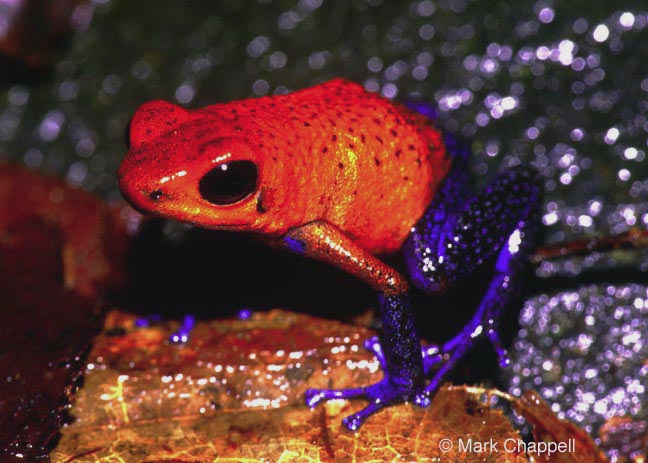
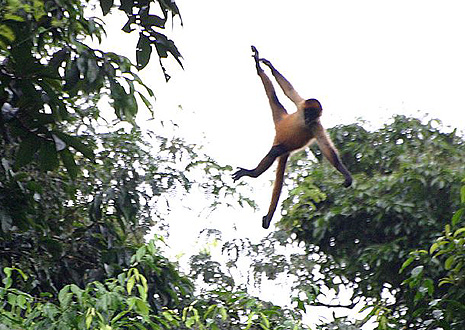
The day after Braulio Carrillo, we went to El Zota, an organic farm, for a tour. While there we helped them make up this soup of microorganisms for their compost pile. Microorganisms help decompose compost faster, and can be used in various other ways around the farm (enhancing fertilizers, cutting down on animal smells). El Zota focuses on cattle, both for dairy and meat production, but they also had pigs, goats, chickens, and an extensive garden. Everything is grown organically, and they maintain a portion of their farm as forest. We got a hike through the forest as well and ended up seeing strawberry poison dart frogs,, a spider monkey, and howler monkeys. I've officially seen all four species of monkeys found in Costa Rica! (Spider, Howler, Squirrel, and White-faced Capuchin in case you were wondering.)
The last day of the trip we visited the Dole Banana Plantation, and were given a tour by a very rehearsed, slippery guide. As another intern put it: "I liked the tour so much it made me suspicious." Some tidbits:
-they actually still use MULES!
-the bananas have to be covered to avoid damage, so all the trees look like they have blue plastic garbage bags hanging from them
-what we think of as a bunch is actually called a hand, and there can be dozens of hands (=over a hundred bananas) on one stalk
-there is no such thing as a banana tree, only banana plants
-banana plants frequently fall over, so all have to be secured by twine to keep them upright
-it's really hard to get bananas to reproduce, so all seedlings are generated in a lab.
This past weekend we took the students to a field station in Guapiles, Costa Rica. We stayed in the field station they used for a semester, which consists basically of cabins. Pictures are on their way, once I can find the time (and Internet) to edit and upload them.
We started the trip with a hike in Braulio Carrillo National Park, which was established in 1978 after the government put a highway through a rainforest. Environmental groups pitched a fit and got the park made. So now they have a national park with a big highway running right down the middle. There's actually a fair amount of "discussion" over what kind of effect this has on the flora and fauna. In ecology, when an ecosystem is broken into pieces (for instance, by agriculture or a highway) it's called fragmentation. Particularly in forests, having more "edges" can drastically change the characteristics of the area. Certain species like to be on the edge and others don't. For example, some birds think an edge means the end of the forest and won't cross it, even though there's another forest 100ft away. Some tree seedlings need shade to grow well and if their seeds land between fragments, they won't survive. This has big consequences for how animals move around and how their populations are regulated. Instead of having one large population with lots of genetic diversity (like a city), you end up with small populations that are very genetically similar (think towns up in the Appalachians...).
The day after Braulio Carrillo, we went to El Zota, an organic farm, for a tour. While there we helped them make up this soup of microorganisms for their compost pile. Microorganisms help decompose compost faster, and can be used in various other ways around the farm (enhancing fertilizers, cutting down on animal smells). El Zota focuses on cattle, both for dairy and meat production, but they also had pigs, goats, chickens, and an extensive garden. Everything is grown organically, and they maintain a portion of their farm as forest. We got a hike through the forest as well and ended up seeing strawberry poison dart frogs,, a spider monkey, and howler monkeys. I've officially seen all four species of monkeys found in Costa Rica! (Spider, Howler, Squirrel, and White-faced Capuchin in case you were wondering.)
The last day of the trip we visited the Dole Banana Plantation, and were given a tour by a very rehearsed, slippery guide. As another intern put it: "I liked the tour so much it made me suspicious." Some tidbits:
-they actually still use MULES!
-the bananas have to be covered to avoid damage, so all the trees look like they have blue plastic garbage bags hanging from them
-what we think of as a bunch is actually called a hand, and there can be dozens of hands (=over a hundred bananas) on one stalk
-there is no such thing as a banana tree, only banana plants
-banana plants frequently fall over, so all have to be secured by twine to keep them upright
-it's really hard to get bananas to reproduce, so all seedlings are generated in a lab.
Sunday, September 4, 2011
Gallivanting
This weekend Nadav (new intern) and I took off for the capital, San Jose. I would like it to be known (coughcoughMom) that we walked throughout the city, couch surfed, and clubbed and came back in one piece, with all of our personal belongings.
For those of you who are unfamiliar with couch surfing, it's a website that connects travelers with locals who are interested in hosting them. Anyone can sign up for it, and people write reviews of their hosts/travelers to maintain a kind of oversight. Hosts aren't supposed to charge, but it's considered good couch surfing manners to help your host out by making dinner or giving them a bottle of wine or something. Treating your host like a hotel is also strongly discouraged- couch surfing is more about cultural exchange than finding a free night's sleep.
In this case we stayed with a 24 year old computer programmer that Nadav had stayed with last weekend. We met at the bus stop, took the bus to his apartment, cooked dinner together, and went out with our host and his friends to Vertigo, a night club in San Jose. He was super welcoming and even though we were a little last minute he fit us in with his friends and their plans. We talked a fair amount in the evening and he cheerfully corrected our Spanish. After the club we slept on his futon, then took the bus into downtown in the morning.
The rest of the day Nadav and I kind of wandered around San Jose and went to the Museo Nacional, which had a lot of Pre-Colombian artifacts. It was also in an old fortress, which was pretty cool. It was pretty chill, just eating when we wanted to eat and stopping where we wanted to stop. Even though we didn't have specific plans it was nice to get out of the center for a while and see the rest of Costa Rica. I think we're going to try to do something like that most weekends, the only problem is limited time. We have to work Saturdays for at least part of the day, and then occasionally we have to be on call for Sundays. But between all three interns and the SAM, I think at least some of us should be able to travel around most weekends. It got really boring hanging around Atenas every weekend during the summer session.
Tomorrow's a pretty big day for the center. Rainforest Alliance comes in the morning to assess the campus for certification. If we get the certification, I think we'll be the only Rainforest Alliance certified study abroad center, and we'll be living up to our "Center for Sustainable Development Studies" name. Later in the day, the students get here! I'm sure we'll be running around all day trying to accommodate everyone.
I'm curious what the semester students will be like. We got a little bit of a profile on them from their applications, so I know there's a lot of really active people in the group. It'll be nice to have them for a longer period of time, I feel like with the summer session I didn't get to know a lot of the students that well, especially if they weren't in Carlos's DR group.
I also realized today that I thought my ~3 months in Mexico lasted forever, but I've already been in Costa Rica 2 months and sometimes I feel like I just got here! Other times it feels like home, particularly when I'm coming back from a trip.
For those of you who are unfamiliar with couch surfing, it's a website that connects travelers with locals who are interested in hosting them. Anyone can sign up for it, and people write reviews of their hosts/travelers to maintain a kind of oversight. Hosts aren't supposed to charge, but it's considered good couch surfing manners to help your host out by making dinner or giving them a bottle of wine or something. Treating your host like a hotel is also strongly discouraged- couch surfing is more about cultural exchange than finding a free night's sleep.
In this case we stayed with a 24 year old computer programmer that Nadav had stayed with last weekend. We met at the bus stop, took the bus to his apartment, cooked dinner together, and went out with our host and his friends to Vertigo, a night club in San Jose. He was super welcoming and even though we were a little last minute he fit us in with his friends and their plans. We talked a fair amount in the evening and he cheerfully corrected our Spanish. After the club we slept on his futon, then took the bus into downtown in the morning.
The rest of the day Nadav and I kind of wandered around San Jose and went to the Museo Nacional, which had a lot of Pre-Colombian artifacts. It was also in an old fortress, which was pretty cool. It was pretty chill, just eating when we wanted to eat and stopping where we wanted to stop. Even though we didn't have specific plans it was nice to get out of the center for a while and see the rest of Costa Rica. I think we're going to try to do something like that most weekends, the only problem is limited time. We have to work Saturdays for at least part of the day, and then occasionally we have to be on call for Sundays. But between all three interns and the SAM, I think at least some of us should be able to travel around most weekends. It got really boring hanging around Atenas every weekend during the summer session.
Tomorrow's a pretty big day for the center. Rainforest Alliance comes in the morning to assess the campus for certification. If we get the certification, I think we'll be the only Rainforest Alliance certified study abroad center, and we'll be living up to our "Center for Sustainable Development Studies" name. Later in the day, the students get here! I'm sure we'll be running around all day trying to accommodate everyone.
I'm curious what the semester students will be like. We got a little bit of a profile on them from their applications, so I know there's a lot of really active people in the group. It'll be nice to have them for a longer period of time, I feel like with the summer session I didn't get to know a lot of the students that well, especially if they weren't in Carlos's DR group.
I also realized today that I thought my ~3 months in Mexico lasted forever, but I've already been in Costa Rica 2 months and sometimes I feel like I just got here! Other times it feels like home, particularly when I'm coming back from a trip.
Tuesday, August 30, 2011
Vacation Update
Vacation Pictures
General Cool Pictures
Bocas del Toro is a relatively small town on Panama's Caribbean coastline. You can tell it used to be nothing more than a typical Caribbean island and has now turned into the "new" typical Caribbean island, complete with bars, dive shops and vendors. It still managed to be pretty charming with colorful houses and most touristy areas limited to the main few streets. I'd say the majority of housing options were hostels (compared to hotels), and I don't think any of the buildings in town even had a third floor.
I stayed at a spanish school/hostel populated by Europeans and you were more likely to hear German than English, although almost everyone spoke English as well. Surprisingly there were quite a few people in their thirties who had been at the school for a month or were planning on staying for weeks. I expected everyone to be college students on break.
I definitely enjoyed the people at the school, but it was a bit difficult to be there on my own, since most of them spent at least half the day in class. I ended up doing a few tours on my own, and went to the beach with a pair of Argentine girls who were also staying at the hostel.
I took a short tour through the Smithsonian research station on the island, which was interesting. The facility is pretty new and obviously very nice. We got to hold some starfish, sea urchins and sea cucumbers and ended up seeing some interesting birds in their swamp. Northern Jacana and Boat-billed Heron and a male Passerini Tanager were the coolest. We also saw a few caimans in the pond.
Playa de Estrellas was probably the highlight of the week. Ines, Paz (the Argentines) and I took a local bus to the other side of the island, Bocas del Drago, got off the bus and walked about 30 minutes along the deserted shoreline. You see a hand-painted sign that says Please Do Not Touch the Stars and in the water you can see at least 10 starfish. The ocean was maybe 1-2ft deep for a good 20ft off the coast, and there were seagrass beds and bright starfish. I got to borrow snorkelling gear and further offshore was some soft coral. I ended up seeing a cuttlefish and a snapper fry that kept trying to eat me.
The return trip was a bit annoying, particularly when I got held up a bit at the border and only just caught the bus on the other side. When I finally got back to the center there were two IT guys from headquarters hanging around. We had dinner and on Sunday went to Manuel Antonio National Park, which is woods with pathways to the beaches. The wildlife sighting was unbelievable, easy spots everywhere. We saw three different types of monkeys (white-faced capuchin, squirrel and howler), raccoons, tame white-tailed deer, and a sloth on the way back. The beach was pretty as well.
General Cool Pictures
Bocas del Toro is a relatively small town on Panama's Caribbean coastline. You can tell it used to be nothing more than a typical Caribbean island and has now turned into the "new" typical Caribbean island, complete with bars, dive shops and vendors. It still managed to be pretty charming with colorful houses and most touristy areas limited to the main few streets. I'd say the majority of housing options were hostels (compared to hotels), and I don't think any of the buildings in town even had a third floor.
I stayed at a spanish school/hostel populated by Europeans and you were more likely to hear German than English, although almost everyone spoke English as well. Surprisingly there were quite a few people in their thirties who had been at the school for a month or were planning on staying for weeks. I expected everyone to be college students on break.
I definitely enjoyed the people at the school, but it was a bit difficult to be there on my own, since most of them spent at least half the day in class. I ended up doing a few tours on my own, and went to the beach with a pair of Argentine girls who were also staying at the hostel.
I took a short tour through the Smithsonian research station on the island, which was interesting. The facility is pretty new and obviously very nice. We got to hold some starfish, sea urchins and sea cucumbers and ended up seeing some interesting birds in their swamp. Northern Jacana and Boat-billed Heron and a male Passerini Tanager were the coolest. We also saw a few caimans in the pond.
Playa de Estrellas was probably the highlight of the week. Ines, Paz (the Argentines) and I took a local bus to the other side of the island, Bocas del Drago, got off the bus and walked about 30 minutes along the deserted shoreline. You see a hand-painted sign that says Please Do Not Touch the Stars and in the water you can see at least 10 starfish. The ocean was maybe 1-2ft deep for a good 20ft off the coast, and there were seagrass beds and bright starfish. I got to borrow snorkelling gear and further offshore was some soft coral. I ended up seeing a cuttlefish and a snapper fry that kept trying to eat me.
The return trip was a bit annoying, particularly when I got held up a bit at the border and only just caught the bus on the other side. When I finally got back to the center there were two IT guys from headquarters hanging around. We had dinner and on Sunday went to Manuel Antonio National Park, which is woods with pathways to the beaches. The wildlife sighting was unbelievable, easy spots everywhere. We saw three different types of monkeys (white-faced capuchin, squirrel and howler), raccoons, tame white-tailed deer, and a sloth on the way back. The beach was pretty as well.
Tuesday, August 23, 2011
A fuller account of Finca la Flor! Stay tuned for photos, I didn't bring my camera connector cord with me to Panama. By the way, Mom, I'm safe and sound in my hostel and the town is super super safe.
So Finca la Flor is an organic farm that also hosts groups for vacations. The farm part isn't too large, just enough to help support themselves and sell excess food. There are maybe 3-5 people who work year round for the farm, and usually a handful of volunteers. I worked with a French Canadian man and a Swiss woman, and the farm is owned by a German woman. I definitely improved my Spanish, since I didn't speak English all week.
We would start around 8 in the morning, usually doing something with planting or preparing ground for planting. We'd have to till the ground (with hoes), add some compost and mix it into the soil, and either plant seeds or replant seedlings. I'd never heard of some of the things we planted, or ate. We also spent some time repairing infrastructure around the farm, using bamboo to make beds or steps on the hills. It was pretty hilly so the beds were all terraced, which is pretty cool.
We also worked with their goats a little. They had them in this stable that was on stilts, so all the goat poop (theoretically) would fall through the slats to the ground. The goats were like penthouse residents. Once a day we'd let them out for the Running of the Goats into their field. Then we'd clean their stalls (basically poking poop through the slats with sticks) and get them back in their stalls later in the day. This was harder, since each goat had an assigned stall so they wouldn't bully each other. So there would be 10 goats milling around and you'd have to sort them by grabbing their horns and trying to convince them to go to their own stall, which was not always easy.
The food was pretty amazing, it was all vegetarian and the majority of it came from the farm itself. The cooks really knew what to do with it too. We had a lot of really fantastic soups, and one night they made a really good Italian style pizza.
I wish I'd stayed longer, and I may go back during other breaks.
So Finca la Flor is an organic farm that also hosts groups for vacations. The farm part isn't too large, just enough to help support themselves and sell excess food. There are maybe 3-5 people who work year round for the farm, and usually a handful of volunteers. I worked with a French Canadian man and a Swiss woman, and the farm is owned by a German woman. I definitely improved my Spanish, since I didn't speak English all week.
We would start around 8 in the morning, usually doing something with planting or preparing ground for planting. We'd have to till the ground (with hoes), add some compost and mix it into the soil, and either plant seeds or replant seedlings. I'd never heard of some of the things we planted, or ate. We also spent some time repairing infrastructure around the farm, using bamboo to make beds or steps on the hills. It was pretty hilly so the beds were all terraced, which is pretty cool.
We also worked with their goats a little. They had them in this stable that was on stilts, so all the goat poop (theoretically) would fall through the slats to the ground. The goats were like penthouse residents. Once a day we'd let them out for the Running of the Goats into their field. Then we'd clean their stalls (basically poking poop through the slats with sticks) and get them back in their stalls later in the day. This was harder, since each goat had an assigned stall so they wouldn't bully each other. So there would be 10 goats milling around and you'd have to sort them by grabbing their horns and trying to convince them to go to their own stall, which was not always easy.
The food was pretty amazing, it was all vegetarian and the majority of it came from the farm itself. The cooks really knew what to do with it too. We had a lot of really fantastic soups, and one night they made a really good Italian style pizza.
I wish I'd stayed longer, and I may go back during other breaks.
Friday, August 19, 2011
Vacaciones
A quick update! I ended up spening the last week volunteering at Finca La Flor, an organic farm near Cartago. Pardon typos and lack of apostrophes, Im using an internet cafe keyboard and I forget how to do them. Finca la Flor is really gorgeous and a pretty cool place. We spent most of every day planting, weeding, and preparing the beds for planting. Its pretty tough work, and at the moment Im exhausted. Ive got another night at the Finca, then Im spending the night in San Jose and heading to Bocas del Toro Panama for a week. Ill give a more detailed post (complete with pictures) next week, when I dont have a bus to catch!
Wednesday, August 10, 2011
In which not much happens...
Dad has been begging me to post for a week now, but frankly I have nothing much to post! The past week was fairly boring since we didn't go anywhere. The students were busy writing up their research reports and the interns (myself and Daniela) took inventories and tried to stay busy (sometimes easier said than done).
The students all left yesterday morning and we had a staff party last night. So far, every Costa Rican party I've been to (total: 3) has included chicharrones, which are different than those made in Mexico or So Cal. Here chicharrones is pork slow cooked over a fire, as opposed to essentially roasted scrapple in Mexico. Each party has also included karaoke and dancing, although the karaoke may be attributed to Sergio (econ professor) who was a key player in both parties. My latin dancing skills are still shameful, but improving. Edgardo (ecology prof) and the guards took pity on me and tried to teach me. Edgardo would try to spin us and I'd miss his hands as he came around and it was generally hilarious.
I believe Mom has been working herself into a knot because I still haven't finalized my plans for my vacation time. I'm waiting on an answer from an acquaintance of Gerardo (center director) about macaw research, but I'm afraid if I don't hear soon I'll have to find something else to do. So for now I'm looking at some organic farms that do kind of a work program. The problem is finding something on short notice. Of course, I'm welcome to stay at the center but that would be fairly boring for three weeks. I also have to leave the country for a few days to renew my visa, which SFS will pay for. I think I'll let them pay for me to go to Bocas del Toro, Panama which is a set of islands on the Caribbean coast of Panama.
The students all left yesterday morning and we had a staff party last night. So far, every Costa Rican party I've been to (total: 3) has included chicharrones, which are different than those made in Mexico or So Cal. Here chicharrones is pork slow cooked over a fire, as opposed to essentially roasted scrapple in Mexico. Each party has also included karaoke and dancing, although the karaoke may be attributed to Sergio (econ professor) who was a key player in both parties. My latin dancing skills are still shameful, but improving. Edgardo (ecology prof) and the guards took pity on me and tried to teach me. Edgardo would try to spin us and I'd miss his hands as he came around and it was generally hilarious.
I believe Mom has been working herself into a knot because I still haven't finalized my plans for my vacation time. I'm waiting on an answer from an acquaintance of Gerardo (center director) about macaw research, but I'm afraid if I don't hear soon I'll have to find something else to do. So for now I'm looking at some organic farms that do kind of a work program. The problem is finding something on short notice. Of course, I'm welcome to stay at the center but that would be fairly boring for three weeks. I also have to leave the country for a few days to renew my visa, which SFS will pay for. I think I'll let them pay for me to go to Bocas del Toro, Panama which is a set of islands on the Caribbean coast of Panama.
Subscribe to:
Posts (Atom)